
One of the most common planning questions we hear about the Galápagos is: what's actually on each island, and do I need a cruise to see it? It's a fair question. Some of the best wildlife sites are just a short taxi ride from a hotel, while others are only reachable if you're living aboard a cruise ship for a week.
We put together this guide after digging into every visitor site across the archipelago. I've done my best to list the major tourist sites on each island, what wildlife you'll actually see, and whether it's a DIY day trip, a guided tour, or cruise-only territory. Whether you're planning a land-based trip, a cruise, or some combination of both, here's the breakdown, island by island.
Hope you find it helpful as you plan your own Galapagos adventure!
Jump to:
- Map of the Galapagos Islands
- Santa Cruz Island
- Bartolomé Island
- South Plaza Island
- North Seymour Island
- Santa Fé Island
- Floreana Island
- Rábida Island
- Santiago Island
- Sombrero Chino (Chinese Hat)
- Daphne Major
- Pinzón Island
- Mosquera Islet
- Isabela Island
- Fernandina Island
- San Cristóbal Island
- Española Island
- Genovesa Island
- Marchena Island
- Pinta Island
- Darwin Island
- Wolf Island
- Final Thoughts!
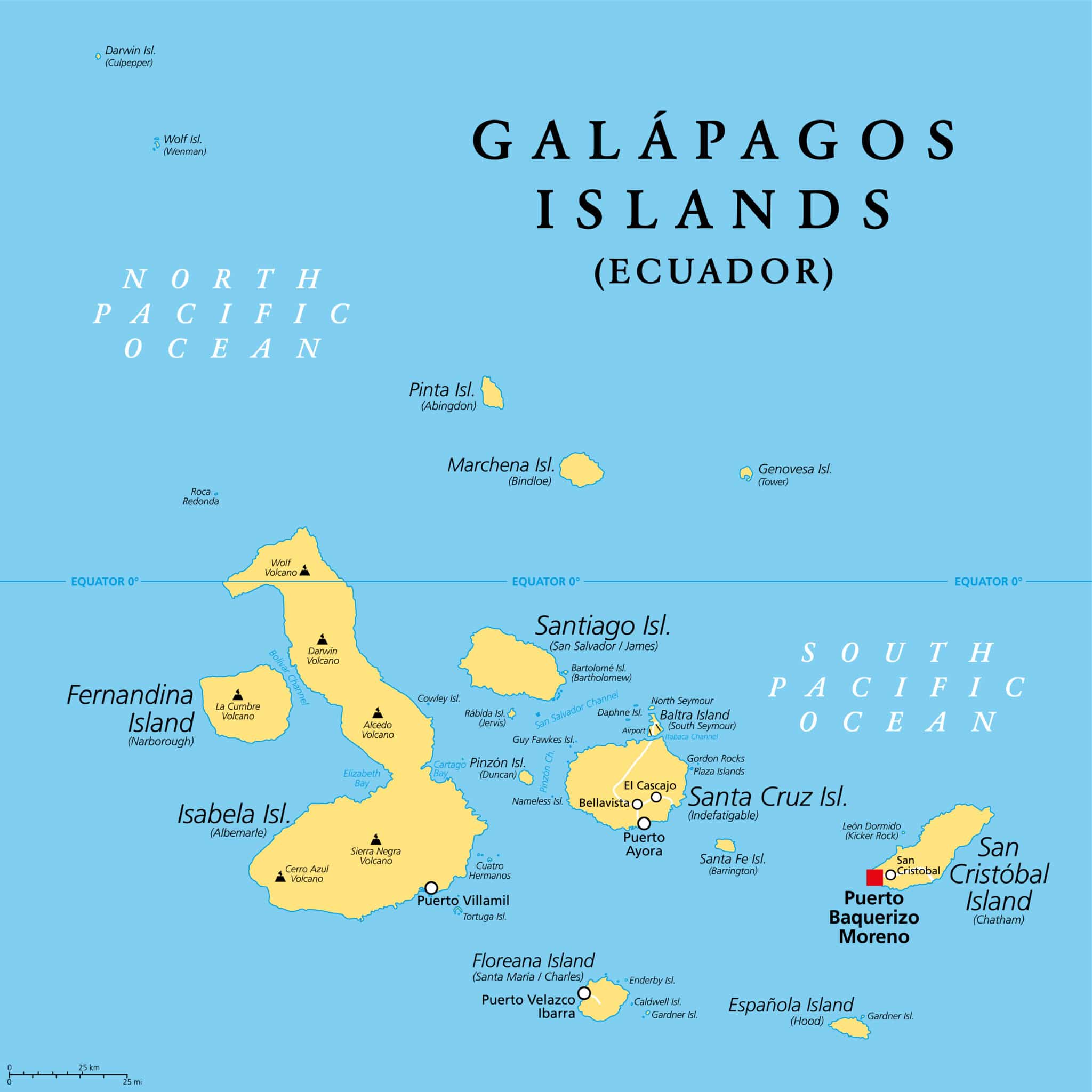
Map of the Galapagos Islands
Let's kick things off with a map of the entire Galápagos archipelago. In total, there are 127 islands, islets, and rocks scattered across this stretch of the Pacific - but don't let that number scare you off. Only 13 are considered the "major" islands, and far fewer than that actually see regular visitors. This guide covers the ones you're likely to encounter, whether that's a quick stop on a cruise itinerary or a day trip from a land base.
Santa Cruz Island
Santa Cruz is the most populated and most visited island in the Galápagos, and the main hub for land-based travelers. Puerto Ayora is the largest town in the archipelago and the jumping-off point for most day tours and cruises. The island has a lot to offer on its own - and it's also the home base for day trips to many of the best nearby sites.
Puerto Ayora & the Waterfront
Wildlife to see here: sea lions, marine iguanas, pelicans.
The main town of the Galápagos. The waterfront is free to wander, and wildlife shows up casually - sea lions lounge on the docks, pelicans scope out the fish market, and marine iguanas sun themselves along the rocks. Good restaurants, many tour operators, and tourist shops are all here.
How to visit: On your own.
Charles Darwin Research Station
Wildlife to see here: giant tortoises (captive breeding program), Darwin's finches, land iguanas.
The research center is the island's most famous landmark. The tortoise breeding program is the main draw - you can see tortoises at every stage of life, from tiny hatchlings to massive adults. Entry to the grounds is technically free, but to walk through the Fausto Llerena Tortoise Rehabilitation Center, you now need to hire an on-site guide for $10/person.
How to visit: On your own (15-20 minute walk from Puerto Ayora, or a short taxi). Some cruise itineraries also include a visit here.
Tortuga Bay
Wildlife to see here: marine iguanas, sea turtles (nesting, seasonal), blue-footed boobies, rays in the shallows
A long, beautiful white-sand beach about 1.8 miles (3 km) from Puerto Ayora. The paved trail out from town winds through dry Galápagos scrubland and is an experience in itself. The main beach has rough surf; the sheltered inner cove at the far end is the spot for swimming. Free and beautiful.
How to visit: On your own. Walk (~45 minutes each way) or take a water taxi from the main pier. If you would like to hike one way and take the water taxi back, be sure to buy your return water taxi ticket in town before you start the hike.
Las Grietas
Wildlife to see here: colorful reef fish, occasional sea turtles, sea lions
A natural swimming hole tucked into a narrow volcanic crevice, with cool, clear water between dramatic lava walls. Popular for snorkeling and swimming. Gets busy midday - go early.
How to visit: On your own - water taxi from the main dock to the Finch Bay Hotel landing, then a short walk. $10/person entrance fee.
Garrapatero Beach
Wildlife to see here: flamingoes (at the inland lagoon), marine iguanas, sea lions
One of Santa Cruz's most beautiful and least crowded beaches. White sand, calm water, and a small lagoon just inland where flamingoes are regularly spotted.
How to visit: On your own. Take a taxi from Puerto Ayora (~30 minutes). Arrange your return ride before your driver leaves- there's no easy way to hail a cab from the beach. Some cruise itineraries will also include a visit here on embarkation or debarkation day.
El Chato Tortoise Ranch & the Highlands
Wildlife to see here: giant tortoises (free-roaming), finches, various birds.
The highlands offer up a completely different side of Santa Cruz - misty, green, and lush compared to the coast. At El Chato and nearby ranches, giant tortoises roam freely across open farmland with no fences or enclosures. There is also a well-preserved lava tunnel that you can take a walk through.
How to visit: On your own. Take a taxi from Puerto Ayora. Many drivers will wait and bring you back, but arrange that upfront. Small entry fee at the ranch.
Los Gemelos (Twin Craters)
Wildlife to see here: vermilion flycatchers, Galápagos doves, short-eared owls, Darwin's finches
Two large sinkholes formed by collapsed volcanic chambers, straddling the main road between Puerto Ayora and Baltra. The surrounding Scalesia forest is beautiful and excellent for birdwatching. Often visited on the way to or from the airport.
How to visit: On your own. Take a taxi from Puerto Ayora. This is often combined with a visit to see the tortoise ranches and lava tunnels.
Black Turtle Cove
Wildlife to see here: sea turtles, white-tip reef sharks, golden rays, juvenile hammerhead sharks (seasonal)
A sheltered mangrove inlet on the north coast of Santa Cruz. There is no landing - you explore entirely by dinghy, gliding quietly through the coves while turtles and sharks cruise beneath you.
How to visit: Cruise ship only (panga/dinghy exploration).
Las Bachas Beach
Wildlife to see here: flamingoes (at inland lagoon), sea turtles (nesting, seasonal), marine iguanas
A beautiful beach on the northern coast of Santa Cruz with a small lagoon frequented by flamingoes. Best known as a sea turtle nesting beach.
How to visit: Cruise ship only.
Dragon Hill (Cerro Dragón)
Wildlife to see here: land iguanas (large colony), flamingoes, Darwin's finches
A site on the northwestern coast of Santa Cruz known for one of the highest concentrations of land iguanas in the Galápagos, following a successful breeding and reintroduction program. A flamingo lagoon at the base adds another highlight.
How to visit: Cruise ship only.
Bartolomé Island
Wildlife to see here: Galápagos penguins, sea turtles, white-tip reef sharks, rays, colorful reef fish, Galápagos hawks
One of the most dramatic-looking islands in the archipelago - a volcanic landscape rising to a famous pinnacle with 360° views. The snorkeling is exceptional, and while 95% of the penguin population lives in western Isabela and Fernandina, this place hosts a small colony as well. If you won't make it to the western islands, this is your best bet for spotting a penguin.
How to visit: Full-day tour from Puerto Ayora (~7-8 hours, departures around 6-7 AM); or via cruise ship.
South Plaza Island
Wildlife to see here: land iguanas, hybrid iguanas (land/marine cross), sea lions (large bachelor colony), swallow-tailed gulls, red-billed tropicbirds, Nazca boobies
A small island with a striking red and green landscape. Dense iguana populations and a sea lion bachelor colony along the cliffs make for excellent wildlife viewing. Primarily a hiking site with optional snorkeling.
How to visit: Full-day tour from Puerto Ayora; or via cruise ship.
North Seymour Island
Wildlife to see here: blue-footed boobies, magnificent frigatebirds, land iguanas, sea lions
One of the best places in the Galápagos for birdwatching. Blue-footed boobies perform their famous mating dance right on the trail in front of you, and frigatebirds inflate their dramatic red throat pouches overhead.
How to visit: Full-day tour from Puerto Ayora; or via cruise ship.
Santa Fé Island
Wildlife to see here: Santa Fé land iguanas (found nowhere else), sea lions, Galápagos hawks, lava lizards
A quieter, less-visited island with a calm beach landing, a resident sea lion colony, and its own subspecies of land iguana - larger and paler than those on other islands.
How to visit: Full-day tour from Puerto Ayora; or via cruise ship.
Floreana Island
Wildlife to see here: flamingoes, sea turtles (nesting), Galápagos penguins, white-tip reef sharks, rays, marine iguanas
A longer day trip, but Floreana offers things you won't easily find elsewhere: a green-sand beach, a flamingo lagoon, and excellent snorkeling at Champion Islet. Floreana also has a fascinating and somewhat mysterious human history worth reading about before you go - look up the Galapagos Affair. This is also the place to find the famous Post Office Bay, where you can leave a letter and pick one up to hand deliver to someone back home.
How to visit: Full-day tour from Puerto Ayora (longer travel time than other day trips); or via cruise ship.
Rábida Island
Wildlife to see here: flamingoes, pelicans (nesting colony), sea lions, marine iguanas, brown noddies.
Rábida is best known for its striking dark red sand beach - the color comes from iron-rich volcanic rock, and it's unlike anything else in the Galápagos. A saltwater lagoon just behind the beach is a reliable spot for flamingoes, and a large pelican nesting colony lives in the trees nearby. Good snorkeling just offshore.
How to visit: Full-day tour from Puerto Ayora; or via cruise ship.
Santiago Island
Santiago is one of the larger uninhabited islands and has two main visitor sites, each with a very different character. So I will break them out here for you.
Puerto Egas (James Bay)
Wildlife to see here: Galápagos fur seals, marine iguanas, herons, oystercatchers, flamingoes (at salt crater lake), sea turtles and reef fish and white-tipped reef sharks while snorkeling.
A dramatic black lava coastline with tidal grottos where Galápagos fur seals shelter in the shade and cool pools. One of the best places in the islands to see fur seals up close. An inland trail leads to a salt mine crater with a seasonal lagoon where flamingoes can sometimes be spotted.
How to visit: Cruise ship; some day tours from Puerto Ayora also visit Puerto Egas, often combined with Bartolomé.
Sullivan Bay
Wildlife to see here: limited, likely various birds
The draw here is the landscape itself. An extraordinary expanse of pahoehoe lava from an 1897 eruption, still largely barren and perfectly preserved. Walking across it feels like being on another planet. Small lava cactus plants are slowly colonizing the edges. Often combined with a stop at Bartolomé, which sits just across the water.
How to visit: Full-day tour from Puerto Ayora (often combined with Bartolomé); or via cruise ship.
Sombrero Chino (Chinese Hat)
Wildlife to see here: Galápagos penguins, sea lions, marine iguanas, Sally Lightfoot crabs, reef fish while snorkeling.
A tiny islet just off the southeastern tip of Santiago, named for its hat-like volcanic shape when seen from the water. The snorkeling around the rocky shoreline is excellent, and penguins are sometimes spotted here.
How to visit: Cruise ship only. Access is strictly limited - only two boats are permitted at a time - so it appears on fewer itineraries than other sites.
Daphne Major
Wildlife to see here: blue-footed boobies, Nazca boobies, red-billed tropicbirds, magnificent frigatebirds, Darwin's finches.
A steep-sided tuff cone rising dramatically from the ocean, Daphne Major is best known as the site of the famous long-term finch research by Peter and Rosemary Grant. Landing is not permitted and access is limited by the National Park. Primarily known for its large booby colonies and scientific significance.
How to visit: Access to the island is limited to only scientific purposes with a permit from the national park. However, some day tours or cruises may circumnavigate the island for birdwatching.
Pinzón Island
Wildlife to see here: Galápagos penguins, sea lions, sea turtles, white-tip reef sharks, rays, large schools of fish.
A small, seldom-visited island off the west coast of Santa Cruz, with outstanding snorkeling in clear water. Penguins are frequently seen here - making it a good alternative if Bartolomé or the western islands aren't in your itinerary. Low foot traffic means a quieter experience than many other sites.
How to visit: Full-day tour from Puerto Ayora; or via cruise ship.
Mosquera Islet
Wildlife to see here: Galápagos sea lions (large colony), shore birds, lava gulls.
A tiny, flat sandy islet sitting in the channel between Baltra and North Seymour. It has one of the largest sea lion colonies in the Galápagos - the beach is absolutely covered with them. There's not much else here, but if you love sea lions, it delivers.
How to visit: Typically combined with a North Seymour day tour from Puerto Ayora; or via cruise ship.
Isabela Island
Isabela is the largest island in the Galápagos by a wide margin - it's bigger than all the other islands combined. It's shaped like a seahorse and formed by six shield volcanoes, several of which are still active.
Puerto Villamil on the southern tip is the main town and a great home base for a land-based trip. The western coast of the island is where you'll find the highest concentrations of penguins and flightless cormorants in the entire archipelago - but those sites are only reachable by cruise. One notable exception to the usual pattern: Los Tuneles is one of the best snorkeling sites in the Galápagos and can only be visited from a land base, not by cruise ship. Let's get into it!
Puerto Villamil
Wildlife to see here: sea lions, marine iguanas, shore birds.
The main town on Isabela - smaller and quieter than Puerto Ayora, with a relaxed, laid-back feel. The beach in front of town is beautiful and lined with sea lions. Very walkable, with good restaurants and tour operators.
How to visit: On your own.
Wetlands & Flamingo Lagoon
Wildlife to see here: flamingoes, black-necked stilts, white-cheeked pintail ducks, herons, marine turtles (nesting).
A network of brackish lagoons and mangroves just east of Puerto Villamil. An easy, flat walk on a boardwalk trail from town, and one of the most reliable places in the Galápagos to see flamingoes. Often combined with a visit to the tortoise center.
How to visit: On your own. Short walk from Puerto Villamil.
Arnaldo Tupiza Tortoise Breeding Center
Wildlife to see here: giant tortoises (multiple subspecies, all stages of life).
Similar in concept to the Darwin Station on Santa Cruz - a conservation facility where giant tortoises are bred and raised before being released into the wild. Isabela has five distinct tortoise subspecies (one per volcano), and you can see several of them here.
How to visit: On your own. Short walk or taxi from Puerto Villamil. Small entry fee.
Wall of Tears (El Muro de las Lágrimas)
Wildlife to see here: various birds, marine iguanas, lava lizards.
A sobering piece of history - a large wall built from lava rock by prisoners of the Isabela penal colony in the 1940s and 50s. The wall itself is the attraction rather than the wildlife, but the surrounding landscape and the story behind it are both striking. A popular cycling or walking route from town.
How to visit: On your own. Bike (~$15/day rental) or walk from Puerto Villamil (~6-7 km). Taxis can also take you out and wait.
Concha de Perla
Wildlife to see here: sea lions, reef fish, rays, occasionally penguins and sea turtles.
A small, sheltered snorkeling lagoon just a short walk from the Puerto Villamil dock. Free to access and one of the easiest snorkeling spots in the Galápagos to get to. Sea lions often join you in the water.
How to visit: On your own. Short walk from the dock. Free.
Las Tintoreras
Wildlife to see here: white-tip reef sharks (resting in shallow channels), Galápagos penguins, marine iguanas (large colony), sea lions, blue-footed boobies.
A small islet just off Puerto Villamil with narrow lava channels where white-tip reef sharks rest in the shallows. Walking the trail through the dense marine iguana colony is an extraordinary experience - the iguanas are absolutely everywhere. Good snorkeling just offshore.
How to visit: Half-day guided boat tour from Puerto Villamil. Some cruise itineraries also include a stop here.
Los Tuneles (Cabo Rosa)
Wildlife to see here: Galápagos penguins, sea horses, eagle rays, sea turtles, white-tip reef sharks, blue-footed boobies (nesting on the lava arches), octopus.
One of the most spectacular snorkeling sites in the entire Galápagos - a surreal maze of collapsed lava tubes and arches where the ocean floods through at sea level, creating sheltered pools teeming with marine life. Sea horses cling to the coral, penguins dart through the water, and boobies nest on the lava bridges overhead. Worth going out of your way for. Note: cruise ships cannot access this site - it is only reachable from a Puerto Villamil land base.
How to visit: Guided boat tour from Puerto Villamil.
Sierra Negra Volcano
Wildlife to see here: Galápagos hawks, Darwin's finches, various highland birds.
The draw is the landscape - the second-largest volcanic crater in the world. A challenging but rewarding hike to the rim of an active volcano with a caldera stretching nearly 10 km across. The views are extraordinary on a clear day. An optional extension leads to Volcán Chico, a landscape of colorful volcanic cones and fumaroles. This hike requires a licensed guide.
How to visit: Guided day tour from Puerto Villamil (taxi to trailhead, then hike with guide).
Note all of the remaining sites below for Isabela are cruise-only locations. There is no way to access them without going on a liveaboard cruise. These are some of the most wildlife-rich areas in the archipelago.
Elizabeth Bay
Wildlife to see here: Galápagos penguins, flightless cormorants, sea turtles, rays, white-tip reef sharks, sea lions, pelicans.
A sheltered bay on Isabela's western coast explored entirely by panga. No landing is permitted - you cruise through mangrove channels and around small islets looking for wildlife at the water's surface. Penguins and flightless cormorants are regularly seen here.
How to visit: Cruise ship only (panga exploration, no landing).
Punta Moreno
Wildlife to see here: flightless cormorants, Galápagos penguins, blue-footed boobies, herons, Darwin's finches, flamingoes (at brackish lagoons).
A stark and beautiful landscape of ancient black lava flows punctuated by isolated brackish lagoons. The contrast between the barren lava and the wildlife-filled pools is striking. One of the more remote and less-visited sites on Isabela.
How to visit: Cruise ship only.
Urbina Bay
Wildlife to see here: giant tortoises, land iguanas, flightless cormorants, Galápagos penguins, marine iguanas, flamingoes.
Famous for a dramatic 1954 geological uplift that raised a 6 km stretch of coral reef nearly 5 meters above sea level overnight. You can still see the stranded coral formations today. One of the better spots on Isabela for seeing giant tortoises and land iguanas in the wild.
How to visit: Cruise ship only.
Tagus Cove
Wildlife to see here: flightless cormorants, Galápagos penguins, Darwin's finches, Galápagos hawks.
A historic anchorage on the western coast where sailors and whalers have carved their names into the rock since the 1800s - there's something both fascinating and a little melancholy about it. A trail leads up to a salt-water lagoon with sweeping views, and the snorkeling in the cove is excellent.
How to visit: Cruise ship only.
Punta Vicente Roca
Wildlife to see here: flightless cormorants, Galápagos penguins, Nazca boobies, blue-footed boobies, marine iguanas, seahorses, Mola mola (ocean sunfish, seasonal), fur seals.
A dramatic volcanic formation on Isabela's northwestern tip with some of the best snorkeling in the entire Galápagos. The cold, nutrient-rich waters here attract an exceptional variety of marine life, including the massive Mola mola (ocean sunfish) during the colder months. No landing - explored by panga and snorkeling.
How to visit: Cruise ship only (panga and snorkeling, no landing).
Fernandina Island
Fernandina is the westernmost and most volcanically active island in the Galápagos - La Cumbre volcano has erupted multiple times in recent years. It is also the most pristine: no invasive species have ever established themselves here, making it one of the last truly untouched ecosystems on earth. There is only one visitor site, and the entire island is accessible by cruise only.
Punta Espinoza
Wildlife to see here: flightless cormorants (large nesting colony), marine iguanas (one of the largest colonies in the Galápagos), Galápagos penguins, sea lions, Sally Lightfoot crabs, Galápagos hawks, pelicans.
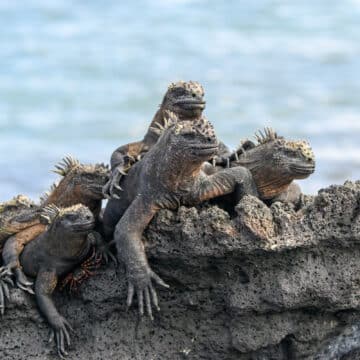
The only visitor site on Fernandina, and one of the most extraordinary wildlife experiences in the archipelago. The marine iguana colony here is massive - the animals are stacked on every surface of the lava, sunning themselves in the thousands. Flightless cormorants nest just steps from the trail, completely unbothered by visitors. The combination of raw volcanic landscape and dense, fearless wildlife is unlike anything else in the Galápagos.
How to visit: Cruise ship only.
San Cristóbal Island
San Cristóbal is the easternmost island in the Galápagos and the seat of the provincial capital, Puerto Baquerizo Moreno. It's the second most popular land base after Santa Cruz, with its own airport receiving daily flights from the mainland. The town is compact and walkable, the sea lion population is enormous and completely unbothered by humans, and the snorkeling at Kicker Rock is among the best in the islands. Several sites are easily reached on your own from town, while others require a guided boat tour.
Puerto Baquerizo Moreno
Wildlife to see here: sea lions (everywhere), marine iguanas, pelicans, frigatebirds.
The island's main town is small, friendly, and very walkable. Sea lions haul out on virtually every bench, dock, and patch of sand in town - they are completely uninterested in giving way to humans, and it's delightful. Good restaurants and tour operators line the waterfront.
How to visit: On your own.
Playa Mann
Wildlife to see here: sea lions, marine iguanas, reef fish while snorkeling.
A small beach right on the edge of town, popular with both locals and visitors. Easy snorkeling just offshore. Sea lions are almost always present on the sand.
How to visit: On your own. Short walk from the town center.
Cerro Tijeretas (Frigatebird Hill)
Wildlife to see here: magnificent frigatebirds (nesting colony), great frigatebirds, blue-footed boobies, tropical birds, sea lions along the coast below.
A well-marked trail from the edge of town climbs to a viewpoint overlooking both the coast and a frigatebird nesting colony. One of the easiest and most rewarding walks you can do independently in the Galápagos. The views from the top are excellent and the trail continues down to a good snorkeling cove.
How to visit: On your own. 20-30 minute walk from Puerto Baquerizo Moreno. Free.
El Junco Lagoon
Wildlife to see here: white-cheeked pintail ducks, common gallinules, frigatebirds (bathe here to rinse salt from feathers), various migratory birds.
The only permanent freshwater lake in the Galápagos, sitting in an ancient volcanic crater in the San Cristóbal highlands. The misty, green landscape up here feels completely different from the dry coast below. A short loop trail circles the lagoon rim.
How to visit: On your own. Taxi from Puerto Baquerizo Moreno (~25-30 minutes). Small entry fee.
La Galapaguera de Cerro Colorado (Tortoise Breeding Center)
Wildlife to see here: giant tortoises (San Cristóbal subspecies, free-roaming in a large reserve).
A tortoise reserve in the highlands where older tortoises roam freely across a large enclosed area - less structured than the breeding centers on Santa Cruz or Isabela, with a more natural feel. Free to enter.
How to visit: On your own. Taxi from Puerto Baquerizo Moreno (~40 minutes, about 22 km). Free entry.
Isla Lobos
Wildlife to see here: Galápagos sea lions, Galápagos fur seals, blue-footed boobies, frigatebirds, reef fish while snorkeling.
A small islet about an hour by boat from Puerto Baquerizo Moreno. Sea lions and fur seals share the rocky shoreline, and blue-footed boobies nest just steps from the trail. Good snorkeling in the surrounding waters.
How to visit: Half-day guided boat tour from Puerto Baquerizo Moreno; or via cruise ship.
Kicker Rock (León Dormido)
Wildlife to see here: hammerhead sharks (seasonal), Galápagos sharks, sea turtles, rays, Galápagos penguins, Nazca boobies, frigatebirds, large schools of fish.
A pair of dramatic volcanic rock towers rising 150 meters straight out of the ocean - one of the most iconic images of the Galápagos and one of the best snorkeling and diving sites in the entire archipelago. You swim through the narrow channel between the two rocks surrounded by marine life. Hammerhead sharks are a regular sighting. Even if you only snorkel in one place on your entire trip, make it here.
How to visit: Full-day guided boat tour from Puerto Baquerizo Moreno; or via cruise ship.
Cerro Brujo
Wildlife to see here: sea lions, shore birds, reef fish while snorkeling.
A remote white-sand beach on the northwestern coast of San Cristóbal, accessible only by boat. Calm, beautiful, and far less visited than the beaches near town. Usually combined with Kicker Rock or Punta Pitt as part of a full-day boat tour.
How to visit: Full-day guided boat tour from Puerto Baquerizo Moreno (typically the San Cristóbal 360 tour); or via cruise ship.
Punta Pitt
Wildlife to see here: red-footed boobies, blue-footed boobies, Nazca boobies, frigatebirds, swallow-tailed gulls, sea lions.
The only site in the Galápagos where you can see all three booby species in one place - that alone makes it worth the trip. Located on the northeastern tip of San Cristóbal, it's a steep hike up from the landing but the wildlife at the top is exceptional. Often combined with Cerro Brujo and Kicker Rock on a full-day tour.
How to visit: Full-day guided boat tour from Puerto Baquerizo Moreno (the San Cristóbal 360 tour); or via cruise ship.
Española Island
Española is the southernmost island in the Galápagos and one of the oldest, which has given its wildlife enough time to evolve into a remarkable number of endemic species found nowhere else on earth. It has two visitor sites, both outstanding. Española is reachable as a day trip from San Cristóbal - it's a long day with about 2.5 hours of travel each way on the water - or via cruise ship.
Punta Suárez
Wildlife to see here: waved albatrosses (the only nesting colony in the world, present April-December), Nazca boobies, blue-footed boobies, red-billed tropicbirds, Galápagos hawks, Española mockingbirds (endemic), Española lava lizards (endemic), marine iguanas (largest and most colorful in the archipelago, with red and green markings).
One of the most spectacular wildlife sites in the entire Galápagos. The waved albatross colony alone - 20,000 nesting pairs performing their elaborate courtship dances - is reason enough to plan a trip around it. Add in the Nazca booby colony, the fearless Galápagos hawks that will land right next to you on the trail, and a dramatic blowhole where waves shoot water up to 75 feet into the air, and you have one of the great wildlife experiences on the planet.
How to visit: Full-day tour from San Cristóbal (~8 hours total, ~2.5 hours each way on the water); or via cruise ship.
Gardner Bay
Wildlife to see here: sea lions (large, relaxed colony), marine iguanas, Española mockingbirds, reef fish while snorkeling, sea turtles.
A long, beautiful crescent of white coral sand on the eastern side of Española. The sea lions here are famously unbothered - you can sit down on the beach and they'll come right up to investigate. Excellent snorkeling just offshore at Gardner Islet and Tortuga Rock, with sea turtles, rays, and reef sharks common. A more relaxed complement to the intensity of Punta Suárez.
How to visit: Full-day tour from San Cristóbal; or via cruise ship.
Genovesa Island
Genovesa - sometimes called "Bird Island" - is a remote, flat island in the far north of the Galápagos, accessible only by cruise. It sits about 4-5 hours by boat from Santa Cruz, which means most cruises need at least five days to include it. For birdwatchers, it's one of the most rewarding stops in the entire archipelago - the sheer density of seabirds here is staggering.
Darwin Bay
Wildlife to see here: red-footed boobies (enormous colony, one of the largest in the world), great frigatebirds, Nazca boobies, swallow-tailed gulls, lava gulls, yellow-crowned night herons, Galápagos mockingbirds, fur seals.
A wide, sheltered beach inside a partially submerged volcanic caldera. You land on the sand and walk through nesting frigatebirds and boobies at close range - birds are perched in the bushes right at eye level on either side of the trail. Excellent snorkeling along the caldera walls.
How to visit: Cruise ship only.
Prince Philip's Steps (El Barranco)
Wildlife to see here: red-footed boobies, Nazca boobies, red-billed tropicbirds, storm petrels (massive colony in the lava cracks), short-eared owls, Darwin's finches.
A steep rocky stairway rising from the water to the island's plateau - named after a visit by Prince Philip in 1964. At the top, the trail crosses an open lava field buzzing with seabirds in every direction. The short-eared owls that hunt the storm petrel colonies here are a remarkable sight.
How to visit: Cruise ship only.
Marchena Island
Marchena is a large, remote island in the northern Galápagos with no official land visitor sites - there are no trails or landings for tourists. Its appeal is entirely underwater. It sits off the main cruise routes and sees very little traffic, which means the marine life is exceptional and largely undisturbed.
Punta Espejo & Punta Mejía (snorkel/dive sites)
Wildlife to see here: scalloped hammerhead sharks (large schools), Galápagos sea lions, fur seals, rays, moray eels, sea turtles, colorful reef fish.
Two marine visitor sites on the southeastern and southwestern coasts respectively. Punta Espejo is known for clear water and reliable hammerhead sightings. Punta Mejía offers grottos and coves with fur seals and reef life. No landing - water activities only.
How to visit: Select cruise itineraries only (snorkeling and diving, no land visit).
Pinta Island
Pinta has no visitor sites open to the general public - landing requires a special permit from the Galápagos National Park, and it does not appear on standard cruise itineraries. It is best known as the former home of Lonesome George, the last Pinta giant tortoise, who died in 2012 and became a global symbol of extinction and conservation. His species cannot be brought back, but restoration efforts on the island itself are ongoing. Pinta is included here for completeness - most visitors to the Galápagos will not set foot on it.
Darwin Island
Wildlife to see here: whale sharks (highly reliable, especially June-November), scalloped hammerhead sharks (large schools), Galápagos sharks, silky sharks, rays, sea turtles, dolphins, Galápagos fur seals, marlins, tuna, large schools of jacks.
Darwin is the northernmost island in the Galápagos, sitting over 100 miles from Isabela - far beyond the range of any standard cruise. There are no land visitor sites and no landings permitted. Darwin exists almost entirely as a diving destination, and it is widely regarded as one of the greatest dive sites on the planet.
The dive site at Darwin's Arch - a natural rock arch just off the island - is world-famous. Schools of hammerheads circling in the blue water, whale sharks cruising through the current, and enormous schools of fish stacked up in the upwelling. Strong currents make this suitable for experienced divers only; Advanced Open Water certification is typically required. There is no snorkeling equivalent to the diving here.
How to visit: Specialist dive liveaboard cruise only. Standard cruise ships do not reach Darwin.
Wolf Island
Wildlife to see here: whale sharks, scalloped hammerhead sharks, Galápagos sharks, silky sharks, bottlenose dolphins (a resident pod of around 200, sometimes snorkeled with in the protected bay), fur seals, rays, sea turtles, large schools of fish.
Wolf sits about 25 miles south of Darwin and is equally remote, equally spectacular underwater, and equally inaccessible without a dedicated dive liveaboard. Like Darwin, there are no land visitor sites and no landings.
Wolf is often paired with Darwin on the same liveaboard itinerary. The diving is comparable in quality - strong currents, large pelagics, and extraordinary shark numbers. A protected bay between Wolf and the nearby Hat Islet is one of the few spots where snorkelers can get in the water and encounter the resident dolphin pod.
How to visit: Specialist dive liveaboard cruise only. Standard cruise ships do not reach Wolf.
Final Thoughts!
With such a wide breadth of sites throughout the archipelago, I hope this little guide gives you a clearer picture of where to actually go - and just as importantly, how to get there.
A few sites here can only be reached on your own from a land base (Los Tuneles is the standout), a lot more are cruise-only, and a handful require serious diving credentials. So don't be afraid to mix and match: many travelers combine a few nights based in Puerto Ayora, Puerto Villamil, or Puerto Baquerizo Moreno with a shorter cruise to reach the sites you can't get to any other way.
If you're still figuring out which cruise fits your wildlife wish list, our guide on how to choose a Galapagos cruise walks through itineraries, ship classes, and budget. And once you've got a plan, check our packing list so you show up with the right gear.
We also wrote up our own five-night cruise on the Ecogalaxy day by day, including several of the sites covered above - Punta Moreno, Elizabeth Bay, Urbina Bay, Tagus Cove, and Punta Espinoza among them - if you want to see what a real itinerary actually looks like in practice. Happy planning!
Leave a Reply